
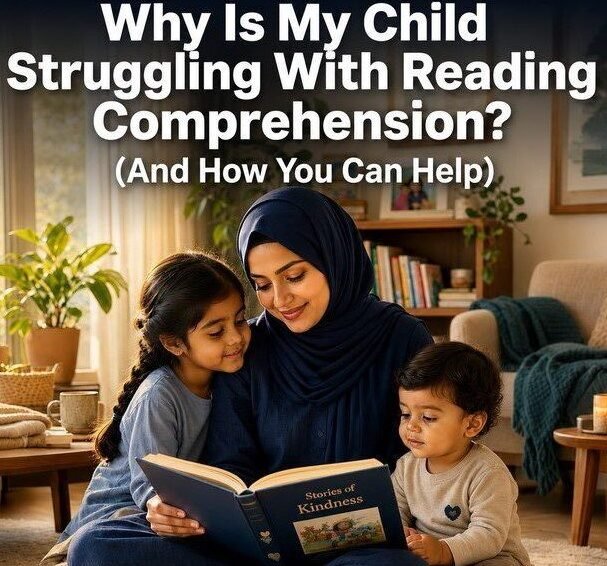
Every parent wants their child to succeed in reading. But what happens when your child can read every word on the page yet still can’t understand what they’ve just read? If your child is struggling with reading comprehension, you are not alone — and help is available.
Introduction
If your child is struggling with reading comprehension, you are not alone. Many parents face this exact challenge every single day. Your child may sit down, open a book, and read every single word on the page fluently — yet when you ask “What was the story about?” they stare at you blankly.
According to the National Assessment of Educational Progress (NAEP), approximately 65% of fourth graders in the United States are not reading at a proficient level. Reading comprehension difficulties are one of the most common academic challenges children face today.
But here is the good news: understanding why your child is struggling with reading comprehension is the first critical step toward helping them improve.
In this comprehensive guide, we will explore the most common causes of reading comprehension struggles, the warning signs every parent should know, and actionable, research-backed strategies you can use at home starting today.
What Is Reading Comprehension and Why Does It Matter?
Before we explore why your child may be struggling with reading comprehension, it is important to understand what reading comprehension actually is.
Reading comprehension is the ability to read text, process it, and understand its meaning. It goes far beyond simply decoding words on a page. True comprehension involves:
- Understanding vocabulary in context
- Making connections between ideas in the text
- Drawing inferences and conclusions
- Recalling details and summarizing information
- Analyzing the author’s purpose and message
Think of reading as a two-part skill:
- Decoding = the ability to sound out and recognize words
- Comprehension = the ability to make sense of those words together
A child can be excellent at decoding yet still struggle deeply with comprehension — and this disconnect is exactly where many parents become confused and concerned.
Key Takeaway: Reading comprehension is not just about reading words correctly. It is about thinking actively while reading.
Common Reasons Your Child Is Struggling With Reading Comprehension
There is rarely a single cause when a child is struggling with reading comprehension. More often, it is a combination of factors working together. Here are the most common reasons to be aware of.
1. Limited Vocabulary Is Causing Reading Comprehension Struggles
One of the biggest predictors of reading comprehension is vocabulary knowledge. If your child encounters too many unfamiliar words in a passage, their brain spends all its energy trying to decode individual words — leaving nothing left for understanding the overall meaning.
Why it happens:
- Limited exposure to diverse reading materials
- Fewer conversations at home involving rich, varied language
- English as a second language (ESL) challenges
What you might notice:
- Your child skips over unfamiliar words
- They cannot explain what certain words mean, even in context
- They lose track of the story when complex language is used
2. Weak Background Knowledge Hurts Reading Comprehension
Comprehension does not happen in a vacuum. When children read, they connect new information to what they already know. If a child has limited background knowledge about a topic, they will struggle to make sense of the text — no matter how well they can decode the words.
For example, a child reading a story about a fishing trip will comprehend it far better if they have actually been fishing or learned about it before.
Why it matters: Research from cognitive scientist Daniel Willingham shows that background knowledge is essential to reading comprehension — sometimes even more important than general reading skill itself.
3. Difficulty With Working Memory Affects Reading Comprehension
Working memory is the brain’s ability to hold and manipulate information temporarily. When reading, a child must:
- Remember what happened at the beginning of a paragraph
- Hold onto character names and details
- Connect new sentences to ones they already read
Children with weak working memory often forget what they read by the time they reach the end of a page. They may need to reread passages multiple times and still feel confused and frustrated.
4. Lack of Reading Fluency Leads to Comprehension Struggles
Here’s a simple truth: if reading feels like hard work, understanding takes a back seat.
When a child reads slowly, stumbles over words, or sounds robotic, their brain is using all its energy just to get through the words. There’s nothing left for actually understanding them.
Quick signs to watch for:
- Reading one… word… at… a… time
- Zero expression — sounds like a robot
- Constant stopping and restarting
- Refuses to read out loud
Think of it this way: Imagine driving in a new city with confusing roads. You’re so focused on not crashing that you can’t enjoy the scenery. That’s what reading feels like for kids who lack fluency.
5. Poor Focus and Attention Impact Reading Comprehension
Let’s be honest — our kids are growing up in a world designed to distract them.
Reading comprehension demands deep, sustained focus. But after hours of fast-paced videos, games, and scrolling? Sitting with a book feels painfully slow.
Common focus-stealers include:
Noisy, chaotic reading environments
Too much screen time (the big one)
Undiagnosed ADHD
Stress or anxiety
Boring reading material
If your child’s eyes are on the page but their brain is replaying a YouTube video — comprehension isn’t happening. Understood.org has great resources on attention and reading.
6.They’re Reading on Autopilot
Here’s something most parents don’t realize: many struggling readers aren’t actually thinking while they read.
Strong readers naturally do things like:
- ???? Predict what happens next
- ❓ Ask questions as they read
- ???? Visualize scenes like a movie
- ???? Connect the story to their own life
- ???? Summarize as they go
Kids who struggle? They just move their eyes across words. No thinking. No engaging. No comprehension.
It’s like the difference between hearing and listening. One is passive. The other takes effort.
7.Learning Disability May Be Involved
Sometimes a child struggling with reading comprehension needs more than extra practice — they need specialized support.
| Condition | What Happens |
|---|---|
| Dyslexia | Decoding is so hard, there’s no energy left to comprehend |
| ADHD | Can’t focus long enough to absorb meaning |
| Language Processing Disorder | Brain struggles to organize language |
| Specific Comprehension Deficit | Reads well but genuinely can’t understand meaning |
Important: Learning disabilities have nothing to do with intelligence. These kids are often brilliant — they just need a different path. Learn more at LD Online.
8. Emotions Are Getting in the Way
This one gets overlooked constantly.
A child dealing with anxiety, low self-esteem, bullying, or family stress simply cannot focus on reading comprehension. Their brain is too busy surviving to learn.
Watch for these emotional red flags:
- Says “I’m stupid” or “I can’t read”
- Gets tearful or angry during reading time
- Completely shuts down when asked about a book
- Avoids school or homework
If reading has become an emotional battleground, the first step is rebuilding confidence — not pushing harder.
9. The Books Are Wrong for Them
This one has a simple fix but makes a massive difference.
- Too hard? → Frustration, shutdown, tears
- Too easy? → Boredom, disengagement, zero growth
The sweet spot is the “just right” level — challenging enough to stretch their skills, easy enough to keep them confident.
Rule of thumb: If your child struggles with more than 5 words on a page, the book is probably too difficult right now.
Warning Signs You Shouldn’t Ignore
Not sure if it’s a real problem or just a rough patch? Look for patterns, not just bad days:
✅ Reads words perfectly but can’t retell the story
✅ Says “I hate reading” regularly
✅ Can’t answer simple questions about what they just read
✅ Grades are slipping in reading-heavy subjects
✅ Takes forever to finish reading assignments
✅ Gets visibly upset during reading time
✅ Can’t explain the main idea of a passage
Seeing 3+ of these consistently? It’s time to act.
5 Proven Ways to Help Your Child Right Now
???? 1. Read Aloud Together (Yes, Even to Older Kids)
This is the single most powerful thing you can do. When you read aloud:
- They hear what fluent reading sounds like
- They can focus on understanding instead of decoding
- You can stop and talk about the story naturally
Don’t stop doing this just because they’re “too old.” They’re not.
❓ 2. Swap “Did You Like It?” for Better Questions
Ditch the yes/no questions. Instead, ask:
- “Why do you think she did that?”
- “What would YOU have done?”
- “What do you think happens next — and why?”
- “Tell me the story in your own words.”
These questions train their brain to think deeply — not just passively absorb words.
???? 3. Build Vocabulary Every Single Day
A child who doesn’t know the words can’t understand the sentences. Simple as that.
Easy daily habits:
- Introduce a Word of the Day at breakfast
- When they hit an unknown word, figure out the meaning together
- Read different types of books — not just one genre
- Talk about new and interesting words during everyday conversations
???? 4. Teach Them to Read Actively
Show your child these five game-changing strategies:
- Predict → “What do you think will happen?”
- Question → “What confuses you? What do you wonder?”
- Visualize → “Picture this scene like a movie.”
- Connect → “Does this remind you of anything?”
- Summarize → “Tell me what just happened in 2 sentences.”
Practice one strategy at a time. Don’t overwhelm them.
???? 5. Make Reading Feel Like Fun — Not Homework
This is non-negotiable. If reading feels like punishment, your child will fight it forever.
Let them choose comic books, graphic novels, or magazines
Try audiobooks during car rides
Pick books about things they’re already obsessed with
Celebrate every milestone — even tiny ones
Remember: A child who reads anything willingly is building comprehension. Don’t gatekeep what “counts” as real reading.